Historic Properties of Spokane
Kroll House
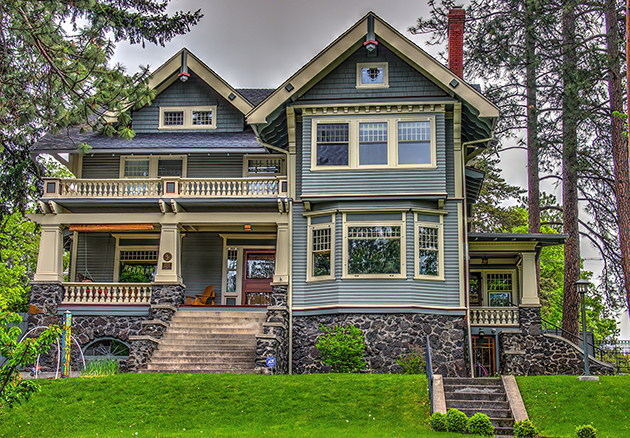
Built in 1910, the Kroll House in the Marycliff-Cliff Park Historic District is an excellent example of the American Arts & Crafts period with an eclectic mixture of influences from Craftsman and Tudor Revival styles. Prominent architectural features include the home’s 2.5 stories, widely overhanging eaves, deep bargeboards with pointed ends, gable peak pendant drops, exposed rafter ends, scroll-sawn brackets, gabled bays with overhanging levels, narrow-width horizontal clapboard siding, basalt rock foundation, multi-windows with small divided lights in the upper sash, and a partial-width front porch and balcony supported by massive exposed beams/joists, and tapered porch posts. The Kroll House was designed by William J. Ballard, founder/president of the Ballard Plannery Company, a prominent architectural firm that practiced in Spokane from 1908 to 1925. A prolific architect, Ballard was venerated in 1912 for his “skill and ability” and positive impact on the Spokane region, an area where Ballard and his firm were responsible for designing more than 600 homes and buildings. The home was first purchased by Anna & William Kroll, “a wealthy Spokane lumberman, market owner, and philanthropist” who “built up and constructed the huge plant of the St. Maries Lumber Company” in St. Maries, Idaho. Praised as a benefactor and civic leader, Kroll bought the Merriam Block (also called the Kroll Building) in downtown Spokane, established a grocery market on the first floor, and helped found and house a philanthropic woman’s club with a membership of 600 women in the building.
The Kroll House s a contributing property in the Marycliff-Cliff Park Historic District, listed on the National Register of Historic Places 12/21/1979.